GLPI Agent 1.7.3 has been released.
Puedes descargarlo en el proyecto github de GLPI Agent: https://github.com/glpi-project/glpi-agent/releases/tag/1.7.3
This version essentially fixes a regression introduced in the MSI packaging for Windows in the 1.7.2 version:
These updates only impact Windows installation performed with MSI packaging.
We invite you to upgrade your agents on Windows as soon as possible.
You don’t need to upgrade to 1.7.3 GLPI Agents that were not installed on Windows and which are at least in 1.7 version.
GLPI Agent 1.7.2 has been released!
Puedes descargarlo en el proyecto github de GLPI Agent: https://github.com/glpi-project/glpi-agent/releases/tag/1.7.2
This version specifically fixes 2 critical security issues related to MSI packaging on windows:
These security issues impact all Windows installation performed with MSI packaging.
We encourage you to upgrade all these agents as soon as possible!
Anyway you don’t need to upgrade to 1.7.2 after updating to 1.7.1 if your GLPI Agent was not installed on windows with the MSI package.
GLPI Agent 1.7.1 has been released.
Puedes descargarlo en el proyecto github de GLPI Agent: https://github.com/glpi-project/glpi-agent/releases/tag/1.7.1
The 1.7.1 version specifically fixes SSL connections problems introduced with 1.7 version update for windows and MacOSX agents but only when you’re using windows keystore or macosx keychain to publish the ssl chain validation for your GLPI server.
You don’t need to update to 1.7.1 after updating to 1.7 if you’re not in that case.
GLPI Agent 1.7 has been released.
You're encouraged to upgrade your GLPI agents or migrate if you're still using FusionInventory agents.
Puedes descargarlo en el proyecto github de GLPI Agent: https://github.com/glpi-project/glpi-agent/releases/tag/1.7
Here is a summary of the most important changes of the 1.7 version:
backend-collect-timeout configuration will apply on the inventoryassetname-support option has been updated to authorize forcing the asset name with its FQDN on linux. Also that option also changes the computing of the agent name in the same way.As always, you can check the more detailed changelog at: https://github.com/glpi-project/glpi-agent/blob/1.7/Changes
About the MSI windows installer, it appears the used perl version is now completely outdated and requires a very big update. This essentially concerns the OpenSSL and libssh2 libraries, the last been used for remote inventory. As we use StrawberryPerl and this project decided to no more support the 32 bits perl version, we decided the 1.7 version will be the last to provide GLPI Agent in 32 bits. This perl update will be the main goal of the next 1.8 version.
Esta nueva versión te permite anular el número de serie:
En las nuevas versiones de Android, ya no es posible recuperar el número de serie ‘real’ del teléfono (considerado como datos sensibles y privados). El agente, por lo tanto, genera un UUID (como recomienda Google -> https://developer.android.com/training/articles/user-data-ids#best-practices-android-identifiers).
Sin embargo, en un restablecimiento de fábrica o al reinstalar el agente de inventario, este UUID cambia. Y cuando se carga un inventario, GLPI creará un nuevo dispositivo (porque el número de serie es diferente). Ahora es posible definir un número de serie (con el que ya está almacenado en GLPI) para evitar duplicaciones en el inventario de GLPI.
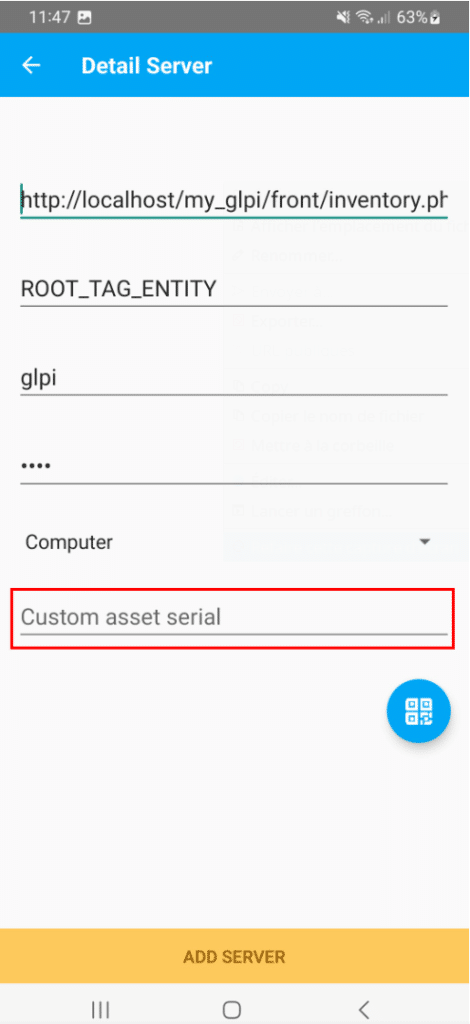
El Configuración del Agente el plugin también ha sido actualizado para incluir un nuevo código QR / enlace profundo en el archivo del dispositivo que contiene el número de serie.
Compatibilidad con Android
| GLPI | GLPIInventario | Configuración del Agente |
|---|---|---|
| 10.0.9 | 1.2.3 | 1.2.0 |
| 10.0.10 | 1.3.x | 1.2.1 |
| Enlace de lanzamiento | Enlace de lanzamiento | Suscripción a GLPI Network |
Google Play https://play.google.com/store/apps/details?id=org.glpi.inventory.agent
GLPI Agent 1.6.1 has been released.
You're encouraged to upgrade your GLPI agents or migrate if you're still using FusionInventory agents.
Puedes descargarlo en el proyecto github de GLPI Agent: https://github.com/glpi-project/glpi-agent/releases/tag/1.6.1
The 1.6.1 version specifically fixes SSL connections problems introduced with 1.6 version update for windows and MacOSX agents.
Here is a summary of the most important changes of the 1.6 version:
log, var y etc folders has been fixed during uninstallation,As always, you can check the more detailed changelog at: https://github.com/glpi-project/glpi-agent/blob/1.6.1/Changes
GLPI Agent 1.5 has been released.
You’re encouraged to upgrade your GLPI agents or migrate if you’re still using FusionInventory agents.
Puedes descargarlo en el proyecto github de GLPI Agent:
https://github.com/glpi-project/glpi-agent/releases/tag/1.5
This release includes a security fix related to CVE-2023-34254. You’ll only be concerned by this security alert if you’re using the remoteinventory task in the case of unix/linux remote inventory via ssh.
Here is a summary of the most important changes:
assetname-support option permits to choose to set asset name from short hostname or fqdn on unix/linux,remote-workers option,Speaking about the MSI packaging, we decided to not sign the packages and provided binaries as code-signing SSL certificate providers are failing to provide us the required certificate in a reasonable time. So you may experience some security alerts until the MSI packages reputation has been nicely established.
As always, you can check the more detailed changelog at:
https://github.com/glpi-project/glpi-agent/blob/1.5/Changes
The presentation is hosted by Alexandre Delaunay, in charge of the GLPI development team and the product owner for GLPI.
In this video he talks about roadmap and some features development team wants in GLPI for the next major version. Here is the transcription:
“To keep the presentation short, we will discuss only about:
- Major topics
- Or very graphical ones
And I would like to insist on the fact that there is no promises of time regarding the delivery.
We will try our best to add the features, but in function of how the year will go, some will be OK, others not.
Now, we have in our marketplace 2 plugins to address generic adds:
- Genericobject
- Fields
We want to add the possibility to let you customize each type of objects displayed in the Assets menu (at first).
The first part of that is to let you define your types.
We will provide a list of predefined types matching the current assets list and let you add new ones if you want. Like servers in addition to desktop or laptop computers. Or to do something completely different from IT management, e.g: cars, desks, etc.
Some of the current types will still be not removable like Software, Rack, Cable, Cartridge and Consumable. The reason is their behavior, or their presentation differs from other assets.
You will still be able to disable these if you want but deletion will be impossible.
So, GENERICITY covers the creation of new asset types.
In addition, on the same setup page, you will be able to define which capacity an asset type use.
E.g. contracts, management, etc., COMPOSITION of an asset type, with some checkboxes to select capacities.
This permits you to remove or add tabs to the object.
Or if an object can be inventoried by an agent.
Let us talk a little about features related to the GLPI inventory agent.
Remote inventory reminder.
Before talking about roadmap, let us do a quick reminder about remote inventory feature
This is a task you can set up for an agent to let it query other computers on your network to construct an inventory file for each.
The single agent will aggregate all inventory files and send them in one pass to the inventory API of GLPI.
So, the main purpose is to have only one deployed agent.
We use SSH and WinRM protocols to achieve that.
GLPI Agent - Roadmap (1/2).
The first point we want to improve is to ease the inventory process of your network.
We currently have two tasks:
- discover which "ping" addresses in an IP range
- network inventory, which takes the result of the discovery to do a full SNMP inventory for network equipment and printers.
We will change the process, by:
- adding remote inventory of COMPUTERS
- and let discovery task directly doing a FULL inventory if it knows the type of the remote device. A SNMP query for network equipment, SSH or WinRm queries for computers.
With one unified task and one setup, we aim to let you discover all your network devices.
The two last bullet points describe things required by unified discovery. The new toolbox UI will receive forms:
- to plan tasks for the agent.
- to save credentials, like SNMP community, login password couple for Windows domain or public key for a SSH connection. In summary, any information to let the agent connect to a remote device.
GLPI Agent - Roadmap (2/2)
We thought about rewriting a large part of the agents, and we shortlisted Golang for that.
The fact the agent is written with the language PERL.
Recently, finding developers comfortable with this language has been hard.
We will try a prototype within the year to measure our capacity to switch to this new language.
We plan also to enforce exchange between agents and backend by adding authentication and registration flows. This will be recommended but you will be able to do simple exchanges if you prefer.
And we still need to redo all forms to drive remotely the agent in GLPI UI.
This is still planned.
Let us talk a bit about features related to the GLPI web application.
High-level API (1/2)
Firstly, we will add a new API, again.
We observe that, despite the old one permits more usage, due to its low-level connection with the framework, it is hard to maintain its stability and avoid regression.
We maintain an interface to address depreciation for this previous API, but it is getting harder and harder to do.
So, a new API connected to a higher level with stabilized endpoints and parameters.
And we took advantage to add some comfort features:
- we have a dedicated UI based on Swagger UI to ease discovering and testing endpoints and their parameters
- we also use RSQL, a common Query language for filtering API.
High-level API (2/2)
For the second slide, you can see in action a GET request to list users in GLPI database.
We want to extend the datacenter features in the next version. Mainly about adding graphical views.
DCIM - Network equipment's panels
The first and the simpler one is graphical panel for network ports list in equipment forms.
We will take the front and rear pictures defined in the model of the equipment and display them above the ports list.
The user will get information about each port directly on the picture panel by hovering them.
A single click on a port will scroll the page to the good line to get more information.
In the model setup, you will have a new tab to draw each port's position.
DCIM - Graphical enclosures (1/2)
In the same way, slots of an enclosure can be drawn and indexed to indicate to GLPI where sub items can be placed.
DCIM - Graphical enclosures (2/2)
On a rack view where an enclosure is inserted, instead of a single blank rectangle, slots will be displayed and usual controls available, like hovering or clicking to get more information.
DCIM - Graphical connections
Finally, for DCIM part, we will try to add some representation for network or power connections.
The goal is to get links between equipment.
This is early to talk about this, we have short specifications for this, and it requires more research to find a library, for example.
Keep in mind the current screenshot does not represent any existing development.
Workflows - Processes
We have a functional prototype for this.
A new view to let GLPI administrator's set up their business processes.
With steps, transitions, conditions and actions, a full toolkit to describe a full workflow.
This aims to replace legacy rules.
And for a start, it will be available for assistance objects like tickets or change.
Nutanix inventory import
Another development currently in alpha is the connector to Nutanix API to get:
- Clusters
- Hosts
- Virtual machines
- Disks
The module parses the distant API and sends them to the native inventory API of GLPI.
The merger with existing devices is done with the rule engine as usual.
SCIM
Another connector, GLPI will serve a SCIM endpoint for your Microsoft Azure instance.
This protocol pushes changes of users from the directory to connected application.
So instead of synchronizing the whole user's database and matching everyone, any change in the directory will be immediately pushed to GLPI.
Now, a security feature, two factors authentication!
Administrators can enforce users' logins in the security setup to ask them to register an external application like Google Authenticator or Authy.
Security - 2 factors (2/2)
After a successful login, a new field will appear asking users to paste a pin code from the authentication application.
Security - Oauth Server
We will add an Oauth server to GLPI for 2 purposes:
- connect applications to GLPI to delegate the login feature and identity management
- secure our several API like inventory one or the general purpose one.
Security - misc
- Vulnerabilities management
- Scanners integration (vuls, tsunamin)
- CVE matching
Some various points:
In the management menu, a new entry to list vulnerabilities.
The goal is, with the help of external scanners, like vuls or tsnunamin, as well as some API to get CVE and match them to known software's to see if a host has some security vulnerabilities.
Some dashboard cards and alerts will also be added to enhance reporting about this subject.
Technical changes
- Web root for the application will be `/public`
- continue work on twig (removing legacy echo)
- removal of legacy auto escaping
- modularization of critical features
- e-charts lib for dashboards
Last slide to tell you we continue to improve the core of GLPI.
The most impactful for you will be the move of the web root of the application.
Now, it will be a sub-folder named /public.
Thereby, all other sub-folders (like files for example) will not be available on the web when the webserver is not well set up.
The next point is legacy codebase we need to clean.
And to finish, we moved to a new charting library called e-charts.
It is simpler to use on our side and you appreciate the new colors and its interactivity.
Timeline?
- Currently, finish stabilize 10.0 version
- End of 2023, beta of next major version
We are still working on bugfixing the 10 version. This last brought substantial changes, especially on the assistance part.
But we aim to work on the incoming yearly results fully on the latest version.
GLPI Agent 1.4 has been released.
You’re encouraged to upgrade your GLPI agents or migrate if you’re still using FusionInventory agents.
Puedes descargarlo en el proyecto github de GLPI Agent:
This release includes few fixes and enhancements.
The most important one fixes a regression introduced in GLPI-Agent v1.3 which prevents windows or macosx agents to communicate with HTTPS GLPI server using a publicly signed SSL certificate.
For the other ones:
As always, you can check the more detailed changelog at:
You’re encouraged to upgrade your GLPI agents or migrate if you’re still using FusionInventory agents.
Puedes descargarlo en el proyecto github de GLPI Agent:
https://github.com/glpi-project/glpi-agent/releases/tag/1.3
This release includes some fixes and enhancements. Here are the most important ones:
As always, you can check the more detailed changelog at:
https://github.com/glpi-project/glpi-agent/blob/1.3/Changes